Showing posts with label guided reading. Show all posts

Monday, August 5, 2013

Monday Made-It: Reading Workshop Assessment + Lesson Planning Pages

I'm linking up with Tara at 4th Grade Frolics for...


Last summer I created a fancy, schmancy system for keeping data for reading and writing based off of the CAFE book. Then the school year started. I love the CAFE book but all the different records became too overwhelming for me. Then I tried a big ole binder with a tab for each student but I couldn't manage that well either. Finally after lots of thinking, talking, and searching I have a new system to try and am hopeful that it's going to be magical! 


Guided Reading/Reading Workshop Assessment

 1. Materials:
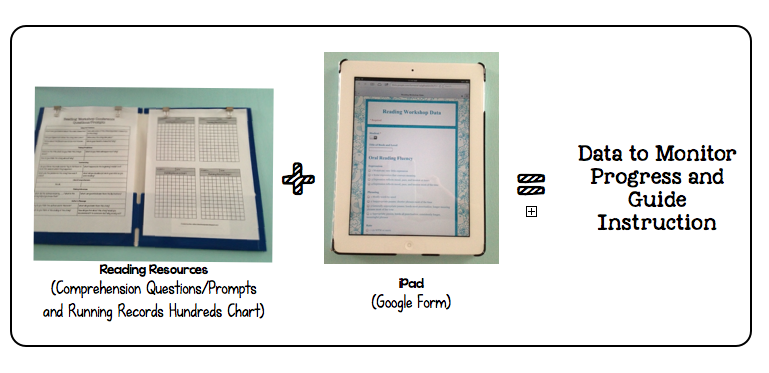
1. Reading Resources (FREEBIES in my TpT store HERE and HERE)
2. iPad or computer 
That's all you need...easy peasy! 


2. Assessment:
Oral Reading Fluency       


Reading Comprehension
Oral Reading Fluency: 
1. Use hundreds charts for Running Records.
2. Record student's performance in Google Form (based on DRA2). 

Reading Comprehension:
1. Use Comprehension Questions/Prompts to guide conference with student.
2. Record quality of student's responses in Google Form (based on DRA2)

No more clutter of papers to worry about! 


3. What now?:
Google Sheets automatically orders the data by date/time but you can order the students by number by clicking the student column and ordering from A-Z. This way each student's data will be grouped together and you can more easily see individual progress.

1. Analyze data in Google Spreadsheet and use to guide instruction!

Grouping students by strategy is made easy!


Would you like to try out this system too? Here's where I found inspiration and tutorials:
Stephanie from 3rd Grade Thoughts
Farrah from Think*Share*Teach
Karyn from Doing the Daily 5!


One more thing...Planning Pages!
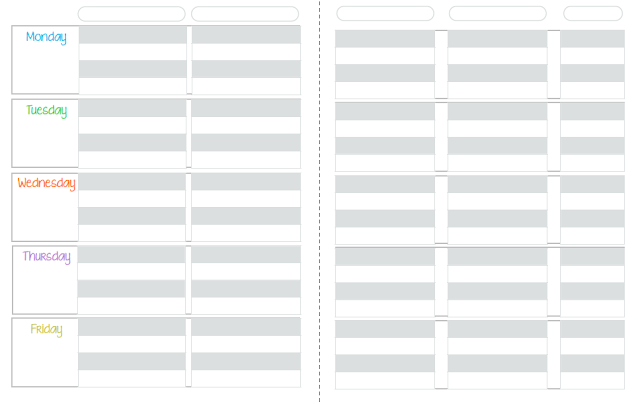
I LOVE to be organized but I was a mess this past year when it came to keeping legible plans. Perhaps at some point I'll make the move to digital plans but for now, I'll use my new planning pages. Download them (click image) for FREE on TeachersPayTeachers!


Happy Monday!

Sunday, July 29, 2012

Managing the Literacy Block (Part 1)

I recently discovered this amazing blog:

The Differentiation Destination

It's a collaborative blog on best practices for differentiating instruction (based off Dr. Carol Ann Tomlinson's work). The four teachers behind this effort just created this blog in July, and I can already tell great info and ideas are going to come from them!

I was in the midst of figuring out how to structure my literacy block with the CAFE and Writers' Workshop when I started feeling SUPER OVERWHELMED...reading conferences, writing conferences, small group (or strategy groups) instruction, whole group instruction, assessments, mini-lessons... my brain was overloaded. So I took a break and stumbled upon a post on flexible groupings from The Differentiation Destination. This post really spoke to me. After reading it, I got the inspiration I needed to put the pieces of the puzzle together. And now I'm ready (and a little afraid) to share it with you. :)

First of all, two of my biggest questions this summer have been:
1. How am I going to manage reading and writing (and math but I'm still working on that one)?
2. How am I going to meet the needs of 27 second graders?


I know many of you have been reading the Two Sisters' CAFE and Daily 5. Both books are such a great resource! I am also a fan of the books below too.


Product Details
Product Details Product Details 


During student teaching I had a binder, like the Two Sisters suggest, and I used elaborate charts and graphs from The Next Step in Guided Reading (I should have read The CAFE Book more carefully because they warned about elaborate charts). I found that I had trouble managing a binder (it just got too crowded) so I have taken the bare necessities and parts from each of these resources to create a system of individual, small, and whole group instruction that will hopefully work for me and my students. As for centers, I'm not going to do the exact model of Daily 5 but I'll post more about that at a later time (you can view my center board here though). It might be too much or not enough but I won't know for sure until I actually meet my students and get in the classroom! Nonetheless, I like to be prepared and would like to share my plans with you anyway. :)


Here is my tentative weekly literacy schedule:
note: to the right of any slashes is what I'm doing with selected students and to the left of any slashes is what the rest of the students are doing

The Meek Moose was recently talking about baby steps and that's what I need to take when introducing all the components of the literacy block to my students.The CAFE Book and Launching the Writers' Workshop give great suggestions on how to get started...the Two Sisters recommend not even starting strategy groups (groups based on need not ability/level) until mid-October. A lot depends on my students too, who I am anxious to meet!


Here is how I will stay organized:


I am going to use magazine boxes (Ikea) and file folders (Target). The pictures above are my reading files and the boxes they are kept in (I have my writing documents set-up the same way). Like I mentioned earlier, the binder didn't work for me but if it works for you, you can easily adapt these files into sections of a binder.


Box 1, Individual Instruction: will house the conference schedule file with (1) reading conference appointments and (2) keeping track form. Each students' reading conference file will also be in this box. I'd also like to put some kind of helpful conferencing resource on the left side (the side that is currently blank) of the student conference form.


Box 2, Strategy Group Instruction: will house file with (1) reading strategy group appointments and (2) reading strategy group lessons. Materials for strategy group lessons will also be placed in this box.


Box 3, Whole Group Instruction: will house file with (1) weekly overview of whole group reading mini-lessons and (2) plans for mini-lessons.  Materials needed for whole group lessons will also be placed in the box.


You can download all the labels and documents (both reading and writing) in my TpT store for free.


If you are interested in learning more about each of these documents, stay tuned for Managing the Literacy Block (Part 2) where I will go into more detail about how I am going to use them, etc. If you have any questions, leave me a comment, and I will try to answer it in my post. :)

Sunday, March 18, 2012

Who loves data?

I do! This has been one of my biggest goals this semester- keeping track of student progress. Not only am I nerd about making organized charts but I love seeing evidence that the students really are learning!

So far, I have a Guided Reading and a Guided Math data binder. I LOVE doing small groups because I feel the small group setting really helps me reach the students better compared to a whole group setting. I still do whole group activities, especially for the introduction of a topic, but then I pull small groups. When I am working with small groups the remaining students are doing Daily 5 during Guided Reading and Math Daily 5 during Guided Math.

I determine the groups for Guided Math based on a pre-assessment (given on Fridays to help me plan for the following week), and I also give exit tickets (formative assessment) throughout the week. For Guided Reading, the groups have been set-up by my Cooperating Teacher based off an assessment called PALs that we have in Virginia.

I still need to develop data sheets for Writers' Workshop so if you have any advice about that I'd love to hear it!

Guided Reading:
Jan Richardson's Next Step in Guided Reading and the two sisters' CAFE have been my bibles! They have given me great direction in what to look for when students are reading and how to help them. I copied a few of the resources from these two books to put in the front of my Guided Reading binder so I can easily refer to them if necessary during Guided Reading.

 Small Group Reading Sheet:
 

Two samples of how I've used the summary section:


Individual Student Reading Record:
In addition to the group data, I will pick one student during a session to record individual progress. This sheet is mostly comprised of a resource from The Next Step in Guided Reading  but I added the goal and strategy section, which I saw in CAFE. I've uploaded both of these reading group data records to Google Docs for you!


For Guided Math:
I keep a formative assessment record, which I have previously posted about. I also keep a small groups data sheet (similar to the reading groups sheet) where I record anecdotal notes and a brief summary of what the students and I did.

 Small Group Math Sheet:
Observation Tasks Record:
Next, I keep an observation task record with individual students' conference sheet. For the observation tasks, I meet with one student at a time for about 2 to 3 minutes and give them a short task do. I have them explain their thinking aloud and justify their answers (I record their responses and/or any notes that I want to remember on the conference sheet). This brief one on one time is very telling! Another great opportunity to clarify students' misconceptions.


 Sample observation task the students did with Judy Clocks:


Individual Math Conference Sheet:
 
Here are two samples of what I recorded for these two students' conference. I write a "p" if I prompted them.


I have uploaded the math small groups data record, the observation tasks record, and math conference record to Google Docs for you! Enjoy!


Site Design By Designer Blogs